
Milan/Kyiv (CI Ukraine) – The proposed acquisition of Banca Monte dei Paschi (1472), the world’s oldest bank based in Siena, by Turin-based Banca Intesa Sanpaolo (1563), the world’s second oldest bank, may be scuttled by allegations of illicit and potentially criminal banking activities involving EU- and US-sanctioned Russian government officials and private sector oligarchs.
Intesa Sanpaolo’s Russian M&A and financial services, mostly initiated by Antonio Fallico, the long-time CEO of its Russian operations, became so prominent that bankers in Milan and beyond refer to Intesa Sanpaolo as “Putin’s bank.”
[Intesa Sanpolao CEO Carlo Messina speaks to Capitol Intelligence/BBN using CI Glass on co-investing with OPIC/IDFC and into minority-owned banks during the IMF World Bank Annual Meetings in Washington, DC. October 18, 2019]
Intesa Sanpaolo’s operations in Russia drew the notice of US and EU regulators when the bank provided EUR 5.2 billion in financing for Qatar Investment Authority’s and Glencore purchase of a 19.5% stake in Rosneft in 2017.
Banking sources with knowledge of Intesa indicate that the US Embassy in Rome formally lodged a complaint with Intesa CEO Carlo Messina, stating that the transaction could be interpreted as a violation of US sanctions against Rosneft, which were established following Russia’s annexation of Crimea in 2014.
Stefano Lucchini, Intesa Sanpaolo’s chief external affairs officer, said the US Embassy had not contacted Messina or Intesa Sanpaolo, and confirmed Intesa’s compliance with US and EU sanctions on Russia.
Messina’s own rise to the top of Intesa Sanpaolo is curious.
Messina began as head of corporate finance at Banca Nazionale del Lavoro in 1987, then joined Banco Ambrosiano, which merged into Banco Ambroveneto and later became Banca Intesa before its merger with Turin’s San Paolo.
BNL was a banking group overseen by the Italian Socialist Party (PSI), while Banco Ambrosiano was considered the most Catholic of the Italian banks and closely linked to Democrazia Cristiana. These two banks represented contrasting political and social factions. Messina successfully left BNL without ever being mentioned in the major BNL Iraqgate scandal of 1989, when Christopher Drogoul, the manager of BNL’s Atlanta branch, channelled $4.5 billion in unauthorized agriculture loans to Iraq’s Saddam Hussein during President George H.W. Bush’s administration.
During his tenure as chair of the parliamentary intelligence oversight committee Copasir, Adolf Urso—currently Italy’s Industry Minister—stated his intention to examine whether Intesa was involved in any investigation initiated by the US government.
US Congressman Darin LaHood (R-Illinois), a member of the House Ways and Means and Intelligence committees, supports tougher secondary sanctions on Russian violators, similar to penalties for companies breaching the US embargo on Iran. The Senate and House will soon approve new “killer sanctions” against Russia and its trading partners in honor of the late US Senator Lindsey Graham.
[Italian Senator and head of Italian intelligence oversight comittee Copasir Adolfo Urso speaks with Capitol Intelligence/CI Ukraine using CI Glass on possible US sanctions against Italian bank Intesa Sanpaolo for the their business activity in Russia at an American Enterprise Institute event with Darin LaHood (R-Illinois) in Washington DC on June 14, 2022]
Igor Sechin, who is now the CEO of Rosneft and considered President Vladimir Putin’s closest associate, has been a significant client of Intesa Sanpaolo as well as a major investor in the Italian tire company Pirelli.
Sechin has been under international sanctions since 2014, with further restrictions imposed after Russia’s invasion of Ukraine on February 24, 2022.
Antonio Fallico, originally from Verona, played a pivotal role in Banca Intesa’s operations in Russia after moving to the former Soviet Union and establishing relationships within Vladimir Putin’s network. As head of Banca Intesa Russia, the Russian subsidiary of Intesa Sanpaolo, Fallico was recognized for his exceptional expertise in merger and acquisition banking, outperforming major international institutions such as Deutsche Bank, Goldman Sachs, and Paribas in this specialized sector.
Antonio Fallico declined to speak with this news organization after reporters visited his office in Verona, where he also serves as the honorary consul general to the Russian Republic.
Fallico distinguished himself from other Moscow-based M&A bankers by reporting directly to Carlo Messina, his CEO. The Qatar-Rosneft mega-deal was a significant achievement for Intesa, typically managed by its much larger international competitors.
Fallico was instrumental in the complex transaction involving the sale of a controlling stake in Italian tyre manufacturer Pirelli to Rosneft and the Russian defense group Rostec. The agreement was discreetly negotiated by Pirelli Chairman and CEO Marco Tronchetti Provera and Rosneft CEO Igor Sechin at a five-star hotel, situated close to the November 26, 2013 summit between President Putin and Italian Prime Minister Enrico Letta in Trieste.
[Pirelli & C Chief Executive Offier and Mediobanca Deputy Chairman Marco Tronchetti Provera speaks to Capitol Intelligence/CI MENA using CI Glass at Fondazione Pirelli. Feb. 9. 2016]
Sechin delivered the keynote at the XVII Verona Eurasian Economic Forum, organized by Fallico in Ras A Kaihmah, UAE, on December 5, 2022—nine months after Russia’s invasion of Ukraine. By then, the US, EU, and G-7 had imposed strict economic sanctions on Russia, including a Swift interbank ban.
Even after Rosneft and Rostec later sold their controlling stakes in Pirelli to Chinese owned state enterprises such as Sinochem, Pirelli continued to allow its company representatives to espouse pro-Putin views.
Pirelli board member Alberto Bradanini, a former Italian ambassador to Beijing, was set to co-host a conference titled “A New Multi Polar World” in Lucca, Italy headlined by Russian extreme right nationalist Aleksandr Dugin, the philosopher created with providing Putin the “moral argument” to invade Ukraine as part of new empire (Novorossiya) of Russian speaking people.
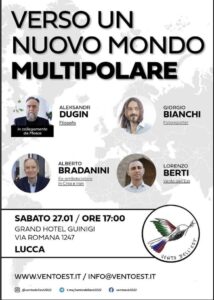
Following widespread protests across Italy, the conference was cancelled. However, Bradanini was not removed from the Pirelli board until both the US and Italy compelled Sinochem to sell its 14% stake to Czech billionaire Michael Strnad, who is active in the defense sector.
According to sources in Rome, individuals associated with Pirelli reportedly persuaded Italian Foreign Minister Antonio Tajani to select Davide La Cecilia, a former Italian Ambassador to Ukraine, as the special envoy leading last year’s Ukraine Recovery Conference in Rome rather than the heroic former Italian Ambassador Pier Francesco Zazzo, who refused to leave his post notwithstanding the arrival of Russian tanks.
Italian and Ukraine government and corporate officials said La Cecilia seemingly went out of his way to sabotage the URC 2025 conference by initially excluding top prospective Ukraine investors such as Fincantieri CEO Pierroberto Folgiero and forcing delegates to bake for more than six hours in sweltering under the Rome July sun to get their conference badge issued.
Intesa Sanpaolo continues to refrain from facilitating transactions in Ukraine, including those for the United States International Development Finance Corporation (DFC), which is leading the multi-billion-dollar US-Ukraine Investment Fund.
Intesa Sanpaolo’s New York City-based Managing Director for Trade and Supply Chain Finance, Marco Fracchia, could not say whether Intesa has a blacklist for Ukraine when questioned by US officials in Prague.
Fallico not only remains listed as the CEO of Banca Intesa Russia but proudly shares a photograph featuring himself with Russian Foreign Minister Sergei Lavrov.
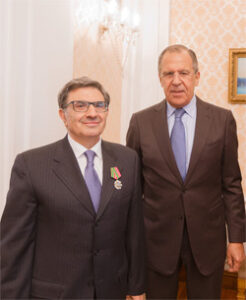
According to an M&A attorney with direct knowledge of the situation, President Putin granted Fallico approval in 2023 to acquire Intesa Zao; however, the transaction was ultimately blocked by Russian Central Bank Governor Elvira Nabiullina.
Italian Treasury Minister Giancarlo Giorgetti reportedly opposes the takeover of MPS by the Intesa Sanpaolo and would prefer to see MPS become part of a third national banking group after Unicredit and Sanpaolo. Giorgetti previously said he was concerned that Unicredit’s activity in Russian could expose the group to international sanctions.
It is yet to be determined whether the Bank of Italy and the European Central Bank will block the merger between the two oldest banks, or if the newly merged bank will face economic sanctions from pro-Ukraine US Treasury Secretary Scott Bessent. ECB Vice President and Croatian National Bank governor Boris Vujčić, declined to comment whether he had any concerns over Intesa Sanpaolo’s exposure to Russia.
This comes as the Trump White House shifts away from Putin and moves closer to Ukrainian President Volodymyr Zelensky.
By PK Semler in Milan, Italy, Washington, DC and Kyiv, Ukraine. For more information, please email pks@capitolintelgroup.com
Copyright of Capitol Intelligence Group – Turning Swords into Equity®